

Music therapy programs for schools, early learning settings, community organisations, and collaborative service partners.
Music Beat Therapy Services provides individualised and group music therapy programs across schools, early learning environments, and community settings.
In addition to clinic-based services, the team also offers in-house music therapy sessions to schools, respite centres, and community organisations across Brisbane, Bayside, Ipswich, Logan, and Moreton Bay.
Our Registered Music Therapists design programs that use music to support health, wellbeing, engagement, communication, learning, and participation. Programs can be delivered as short-term blocks, ongoing groups, or tailored partnerships with organisations seeking responsive and meaningful therapeutic support. Music Beat Therapy Services already delivers both individual and group programs across a range of age groups and settings, including developmental groups and community-based offerings.
We use elements of music and neuroscience to enhance, develop, and maintain the health, functioning, and wellbeing of participants, while adapting sessions to the needs of each environment and community.
Schools and Early Learning
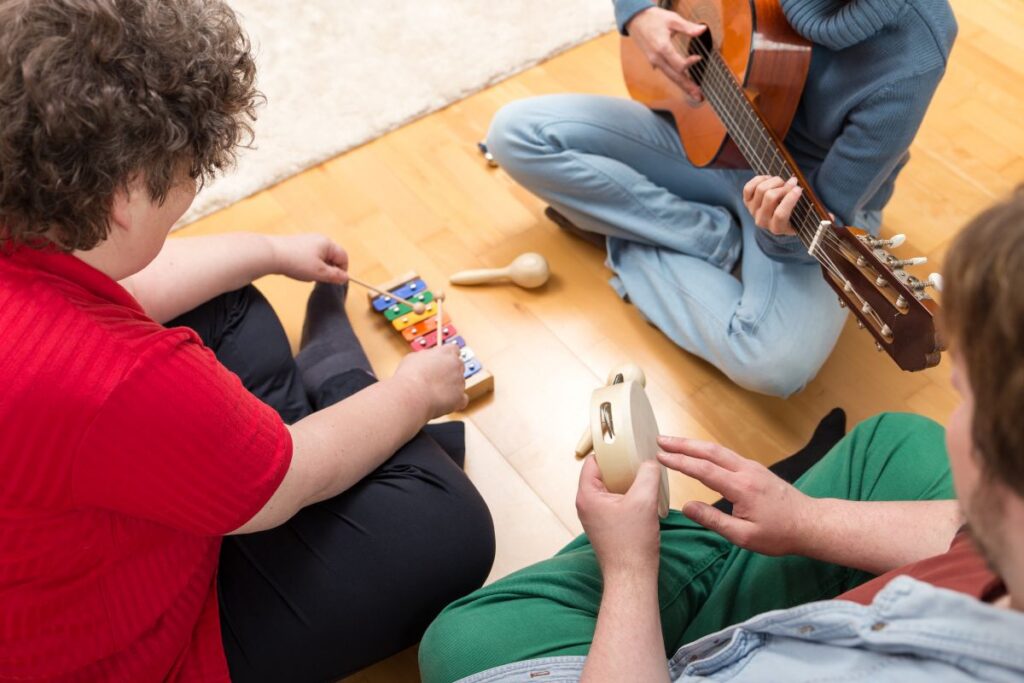
Music therapy can be highly effective in schools, kindergartens, childcare centres, and early learning programs, where music can be used to support development, participation, and classroom engagement.
In these settings, music therapy may be used to support:
- Communication and social interaction
- Attention and focus
- Social/emotional skills
- Sensory processing and body awareness
- Following routines and transitions
- Movement and coordination
- Confidence and self-expression
Music Beat Therapy Services’ existing children’s programs emphasise many of these same developmental goals, including communication, social communication, attention, focus, body awareness, self-regulation, sensory integration, and parent education. The school-aged service page also notes that music therapy can be used alongside the school curriculum and to support students in social situations, emotional regulation, and sensory processing within the school environment.
School and early learning programs can be structured to align with the needs of the setting, whether that involves:
- Small therapeutic groups
- Classroom-based sessions
- Targeted support for identified participants
- Transition and school-readiness programs
- Collaborative work with educators and support staff
Because music is structured, predictable, and engaging, it can help create supportive learning environments where children can build skills while participating in meaningful and enjoyable activities.
Community Programs
Music Beat Therapy Services also offers music therapy in community-based settings, supporting participants to build confidence, connection, and participation outside of the clinic.
Community programs may be appropriate for:
Community music therapy programs can support outcomes such as:
- Increased social connection
- Improved engagement in group activities
- Emotional expression and regulation
- Communication and interaction
- Confidence and self-esteem
- Access to inclusive community experiences
These programs can be especially valuable for participants who benefit from learning and practicing skills in real-world, relational, and community-based environments.

Program Partnerships
Music Beat Therapy Services partners with organisations to design and deliver tailored music therapy programs that meet the needs of their participants, staff, and service model.
Program partnerships may include collaboration with:
Partnership programs can be developed to include:
- Regular on-site music therapy sessions
- Group programs for specific cohorts
- Short-term pilot programs
- Co-designed therapeutic or wellbeing initiatives
- Staff consultation and education
- Support with participant goal-setting and review processes
How Our Programs Work
At Music Beat Therapy Services, we begin with understanding the goals, needs, and context of the people and organisations we support. The service’s broader model includes a personalised three-session assessment process followed by an individualised treatment program, and this same goal-focused approach can be adapted for community and organisational settings.
Depending on the program, this may involve:
- Consultation with the organisation or family
- Observation and assessment
- Identifying therapeutic and functional goals
- Designing an individual or group program
- Delivering sessions on site or in community settings
- Reviewing progress and adapting the program over time
Programs can be offered as one-to-one supports, group-based services, or broader organisation-wide initiatives.
Available Funding Pathways
Depending on the setting and participant group, community and organisational music therapy programs may be accessed through a range of funding pathways.
Kindy Uplift
For eligible Queensland kindergarten services, music therapy programs may be delivered as part of Kindy Uplift initiatives. Kindy Uplift funding is provided to respond to children’s learning and development needs through evidence-based initiatives that improve outcomes for kindergarten children. The program can fund programs, resources, professional development, and supports that build educator capability and strengthen inclusion in approved kindergarten programs. Eligible services in 2026 are Queensland kindergarten services that obtained Kindergarten Program Provider approval before 30 September 2025 and are participating in Free Kindy.
This may make Kindy Uplift a suitable pathway for:
- Early learning music therapy groups
- Inclusion-focused kindergarten programs
- Programs supporting communication, regulation, participation, and engagement
- Collaborative initiatives that build educator confidence and inclusive practice
Because music is structured, predictable, and engaging, it can help create supportive learning environments where children can build skills while participating in meaningful and enjoyable activities.
Out of Home Care Funding
For some school-based programs, music therapy may also be supported through Out of Home Care funding pathways. In Queensland state schools, the Education Support Funding Program (ESFP) provides targeted funding to enhance the learning, wellbeing, and educational outcomes of eligible students in care. Funding is distributed to schools and must be linked to a student’s Education Support Plan (ESP), with expenditure used only for services or resources that directly support learning and wellbeing.
This may support music therapy programs designed to assist eligible students in care with areas such as:
- Emotional regulation
- School engagement
- Participation and connection
- Routine, transition, and wellbeing support
- Communication and social development
As eligibility and school processes apply, access to this funding pathway is typically discussed directly with the school or relevant care team.
Tailored Funding Support
Where appropriate, Music Beat Therapy Services can work with schools, early learning services, and community organisations to explore whether a program may align with available funding streams and organisational priorities.
If you are seeking a program for a kindergarten, school, or community service, our team can discuss options for tailored delivery, partnerships, and possible funding pathways.